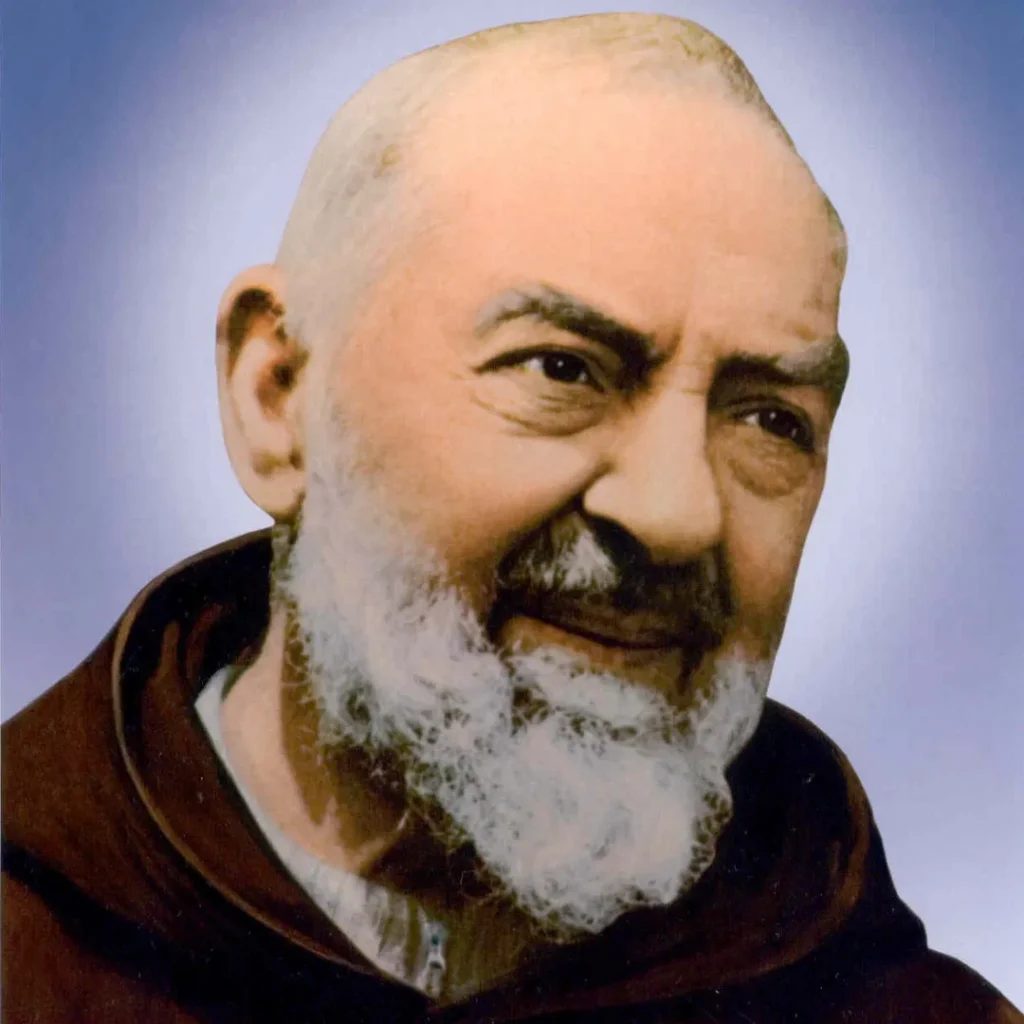
On June 16, 2002, St. Peter’s Square witnessed one of the largest canonization ceremonies in Church history. More than 300,000 faithful, braving the scorching Roman sun, gathered as Pope John Paul II canonized Padre Pio of Pietrelcina. The pope praised him as a man of prayer and charity, whose life testified to the mysterious power of suffering accepted in love.
“This is the most concrete synthesis of Padre Pio’s teaching,” said John Paul II. He reminded the faithful that trials embraced with love become a privileged path to holiness.
From a Humble Village to a Worldwide Witness
Born Francesco Forgione in 1887 to a farming family in southern Italy, the boy who would become Padre Pio lived a simple childhood. Twice, his father even traveled to New York to provide for the family.
At 15, Francesco joined the Capuchin Franciscans, taking the name “Pio.” He was ordained a priest in 1910, but his health was fragile—tuberculosis forced him out of military service during World War I. By 1917, he was sent to the friary of San Giovanni Rotondo, which would become his lifelong home and a place of pilgrimage for millions.
The Mysterious Gift of the Stigmata
On September 20, 1918, while praying after Mass, Padre Pio had a vision of Christ. When it ended, he bore on his body the stigmata—the wounds of Jesus in his hands, feet, and side.
The phenomenon attracted attention from doctors, Church authorities, and the curious. At times, the Church restricted him from public ministry while investigations were carried out. But Padre Pio accepted these trials without complaint, silently carrying his “yoke” with Christlike humility.
Despite skepticism, people flocked to San Giovanni Rotondo. For decades, Padre Pio’s daily routine revolved around confession and the Eucharist. After celebrating a 5 a.m. Mass, he would spend up to 10 hours a day hearing confessions, guiding souls with extraordinary spiritual insight. Many testified that he knew their sins and struggles before they spoke a word.

A Heart for the Suffering
Padre Pio’s love was most evident in his care for the sick. In 1940, he envisioned a hospital that would be a “House for the Alleviation of Suffering.” Despite enormous challenges—hauling water and materials up Mount Gargano—the hospital opened in 1956 with 350 beds. Today, it stands as one of the finest medical centers in southern Italy.
His presence drew countless pilgrims seeking physical and spiritual healing. Many reported miraculous cures through his intercession, while others left with renewed faith after simply attending his Mass.
Misunderstandings and Final Years
Padre Pio also endured slander. False prophecies were circulated in his name, and his popularity often drew the wrong kind of attention—even souvenir hunters who cut pieces of his habit. Yet, he never claimed to predict world events and remained obedient to the Church, submitting his life to God’s will.
On September 23, 1968, Padre Pio died after a life poured out in prayer, suffering, and service. He was beatified in 1999 and canonized in 2002, a moment that confirmed what the faithful already knew: that this humble friar had carried the Cross with extraordinary love.
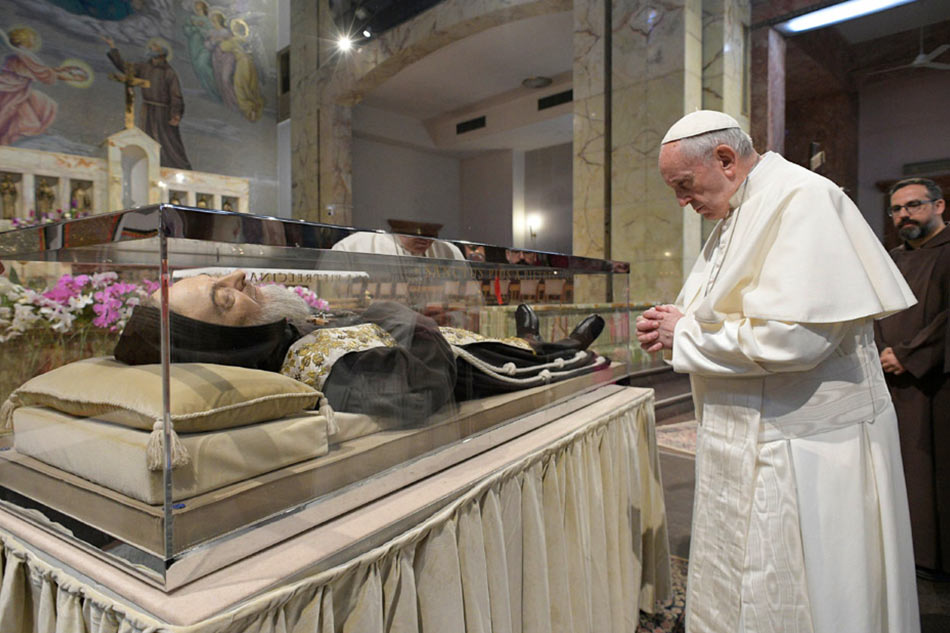
Reflection for Today
At the canonization Mass, Pope John Paul II reflected on the Gospel of the day (Matthew 11:25-30):
“The Gospel image of the ‘yoke’ evokes the many trials that the humble Capuchin of San Giovanni Rotondo endured. Today we contemplate in him how sweet is the ‘yoke’ of Christ and indeed how light the burdens are whenever someone carries these with faithful love.”
Padre Pio’s life is a reminder that holiness is not the absence of suffering, but the transformation of it. His stigmata, his confessional ministry, his hospital for the sick—all point to the truth that when burdens are carried with love, they open the heart to a greater good known only to the Lord.
Prayer to St. Padre Pio
St. Pio of Pietrelcina, wounded healer, teach us to carry our daily crosses with love. Help us see Christ in the suffering, the sick, and the forgotten. Pray for us, that we too may walk the path of holiness with courage and humility. Amen.