
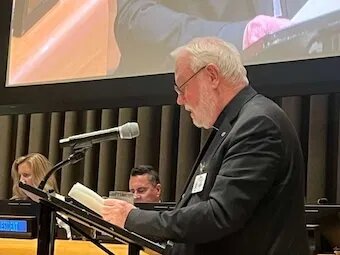
The United Nations hosts a meeting in New York to commemorate the 30th anniversary of the 4th World Conference on Women held in Beijing. Archbishop Paul Richard Gallagher points out the challenges that women and girls still face, and the need to defend their equal dignity and ability to fulfil their potential.
Delivering a speech at a United Nations high-level meeting in New York to commemorate the 30th anniversary of the Fourth World Conference on Women held in Beijing, Archbishop Paul Richard Gallagher reflected on both the progress achieved and the challenges that remain in achieving equality for women. He forcefully called for the defence and upholding of women’s dignity and equality in every sphere of life.
“Thirty years ago, the international community gathered in Beijing to focus on important and urgent questions regarding the dignity of women and the full enjoyment of her fundamental human rights,” the Vatican Secretary for Relations with States and International Organizations recalled. “Since then, although significant progress has been made, there are persistent issues in the Beijing Declaration and Platform for Action that remain unaddressed.”
Poverty, Education, and Economic Inequality
Among these unresolved challenges, Archbishop Gallagher highlighted poverty, education, and economic inequality, noting that their rates remain alarming.
“An extreme degree of poverty among women, obstacles to accessing or even exclusion from quality education, and their lower wages in the workplace impede the full achievement of women’s equal dignity and ability to fulfil their potential in all areas of life,” he said.
Violence Against Women and Girls
With particular concern, the Archbishop denounced the violence women and girls still face: “Wherever it occurs—at home, during trafficking, or in conflict and humanitarian settings—it constitutes an affront to their dignity and is a grave injustice.”
He also warned that “technology is being used to exacerbate certain forms of abuse and violence,” stressing that the problem extends beyond exploitation.
In addition, he drew attention to practices such as prenatal sex selection and female infanticide, which the Beijing Declaration and Platform for Action had condemned but which still rob millions of “missing girls” each year. The Holy See, he insisted, firmly condemns such violence in all its forms, declaring it “never acceptable and must be eradicated.”
Health and the right to life
Archbishop Gallagher also raised concerns about health, noting that while maternal mortality rates have dropped significantly since 1990, progress has stalled in recent years.
“Access to prenatal care and skilled birth attendants, as well as to healthcare systems and infrastructure, must increase,” he urged, while rejecting what he described as “false solutions such as abortion.”
Protecting the right to life, he said, is the foundation of all human rights and underpins every other fundamental freedom.
Equality Rooted in Dignity
He reiterated that equality for women cannot be achieved unless the dignity of every person, especially the most frail and vulnerable—from the unborn to the elderly—is respected.
Finally, he urged governments to remain faithful to the commitments undertaken in Beijing:
“The primary concern of the Beijing Declaration and Platform for Action—which addresses the needs of women in poverty, strategies for development, literacy and education, ending violence against women and girls, a culture of peace, and access to employment, land, capital and technology—still remains neglected. It is the hope of the Holy See that instead of focusing on divisive issues that are not necessarily beneficial to women, their God-given dignity should be respected and fulfilled by the states,” he affirmed.
Credit: Sr. Christine Masivo-Vatican News